Ethiopian Endemic Wildlife
Duration: 10 day Book Now! Day 1: Arrive Addis Ababa, drive to Debre Libanos. Ethio-German Lodge. Day 2: Drive to Awash National Park. Awash Falls Lodge Day 3: Around Awash…
“Good afternoon,
A quick email to thank you for arranging our tour of Northern Ethiopia, all of your ground staff were knowledgeable, interesting, Friendly and punctual (a trait missing in other parts of East Africa!!).Your choices of Hotels/Lodges was excellent and was ideal for the tours we enjoyed.
Many Thanks Again
Alana Jones & Ron James
Barwon Heads Australia”
Tony Hickey,
I recently spent nearly 2 weeks in the Omo Valley and Harar with Daniel Ademe and his driver : Asrat of your firm as part of a 5 week volunteer/touring trip arranged by the Africa Adventure Company and wanted to let you know how much I enjoyed their expert guiding and transportation. Having travelled to 150 countries I think I have a pretty good idea of quality service and Daniel is one of the very best; he is knowledgable, flexible, on top of everything and a genuinely nice guy. Also Asrat is an excellent driver and a very knowledgeable bird guide; he actually got me interested in birds. In addition, the itinerary, accommodations, meals and flights all worked out perfectly. Thank you.
Ken Dubuque
PS Also on my previous trip to Ethiopia 2 years ago with your company I would
commend Daniel Miliron and the arrangements as well.
Adventure-Trekking, Rock-climbing, Caving, and Ballooning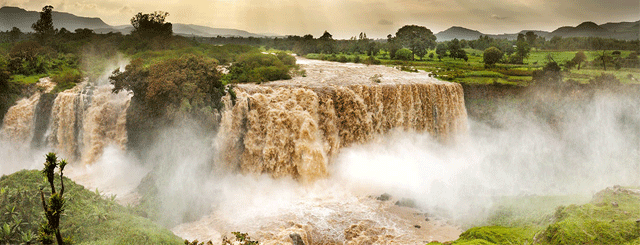
There are many possibilities for trekking in Ethiopia, here are four.
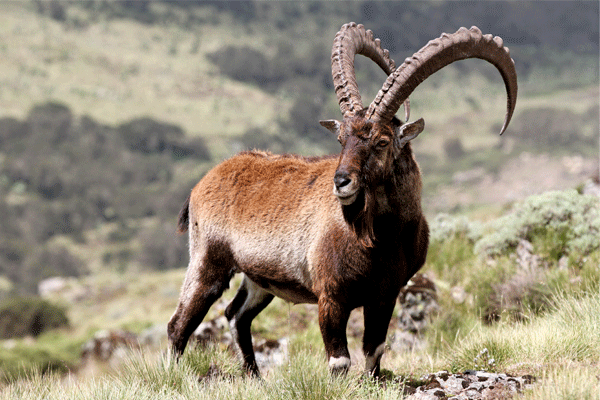
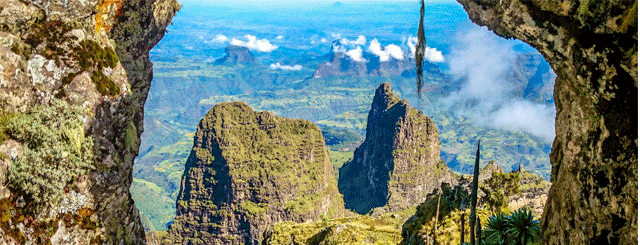
A. The Simien Mountains present perhaps the most dramatic mountain scenery in Africa – great volcanic plugs, formed some 40 million years and eroded over the aeons into fantastic crags, pinnacles and flat topped mountains, “the chess pieces of the Gods” as one writer described them, tower over precipitous gorges, river valleys and plains stretching all the way to Eritrea. There are many peaks over 4000 meters, and Ras Dashen at 4550 meters in the highest in the country and the fourth highest in Africa. While trekking in the Simiens visitors can see the endemic Gelada or bleeding heart monkey, the Walia Ibex, Simien Wolf or Ethiopian Wolf and rock hyrax, endemic birds such as the Thick-billed Raven, Black-headed Siskin, White-collared Pigeon, Wattled Ibis, White-billed Starling, Spot-breasted Plover and White-backed Black Tit, cruising Lammergeyer with their 3 meter wingspan and Afro – Alpine meadows carpeted with flowers and punctuated by the tall spiky kniphofia or “red hot pokers”. You can go in for a day, or go the whole hog and climb Ras Dashen – it is not a technical climb and no special climbing ability is needed. Mules can carry you and your luggage for most of the way. If you are interested in climbing Africa’s fourth highest mountain, Ras Dashen (4550 meters), you should allow eight days in and out. The Simien Mountains can easily be combined with a tour on the Historic Route. Visitors with little time can fly from Addis Ababa to Gondar, some 100 km from the entrance to the park at Debark. For those who do not like camping, there are lodges inside the park near Sankaber and just past Debark town on the way to Limalimo.
B. Good trekking itineraries, by horse or on foot, can also be made in the Bale Mountains National Park, an area of high altitude plateau, with volcanic crags and lakes, forests, alpine moor land, trout filled streams and a striking variety of fauna and flora. Several endemic mammals, including the Mountain Nyala, Simien Wolf and Menelik’s Bushbuck, are found within the park, while 16 endemic bird species have been recorded. In the Harenna Forest in the southern part of the park there are leopards and lions, although the dense forest makes spotting animals difficult. A one-day excursion from Goba (by car) takes the visitor to the fantastic underwater river and caves of Sof Omar. Since it takes one day to get to Bale from Addis Ababa, a minimum of 4 days should be allowed.There is now the very comfortable Bale Mountains Lodge, situated just south of Rira Village at the edge of the Harenna Forest, which can be used as a base for visiting the park.
C. Down in the south, on the west bank of the Omo River are found the Surma, who like some of their cousins on the eastern bank go in for body painting and (the women) wearing lip plates. This is an opportunity to see unspoiled wilderness, a variety of game, more than 300 bird species and of course the Surma people themselves, their rituals, dance and stick fighting. (NB Stick fighting has now been classified as a Harmful Traditional Practice, and it is no longer possible for tourists to attend “donga” or stick fighting.) A minimum of 1 week should be allowed. It takes 2 days by road to where the trek can be started.
D. Village to village trekking: In recent years trekking routes have been established which take visitors from village to village, inside the villages special huts have been set up for tourists. Popular routes are around Lalibela and in the Gheralta region of Tigray – contact us for more details.
Increasingly popular are the opportunities offered in Tigray, around Adigrat (where it is possible to find the indigenous Gelada monkey), in Gheralta and Tembien, where the stunning mountain scenery hosts fascinating rock hewn churches, many with exquisite wall murals and ancient artifacts and treasures.
Rock climbing is not an indigenous sport, but there are excellent sites in Tigray which have been visited in recent years by rock climbing enthusiasts. In the last few years paragliders have found excellent flying in Ethiopia. Caving is similarly not practiced in Ethiopia, but groups from the University of Huddersfield in UK have discovered vast cave complexes in Harerghe, in the east of the country.
White water rafting is generally done on the Blue Nile near Bahir Dar (a few days), along the Omo River (the whole stretch can take up to a month) and on the Awash River (one or two days). Specialized expeditions have tackled other rivers, including the Tekezze, the Beshilo and the Baro. Rafting can only be done at certain times of the year, after the rains, and needs to be set up well in advance. Currently, no company in Ethiopia has the equipment or expertise to mount a rafting expedition – all equipment would need to be brought in.
Caving is similarly not practiced in Ethiopia, but groups from the University of Huddersfield in UK have discovered vast cave complexes in Harerghe, in the east of the country. Now Ethiopia has its own expert speleologist, Nasir Ahmed, who has studied 321 of Oromia’s natural caves, has uploaded 200 maps on Google maps and written a 360 page book titled Caves in Oromia.
The cave system at Sof Omar, formed by the Web River as it goes underground, is said to be the biggest in Africa and one of the biggest in the world. Its passages extend for a total of 16 km, although the route normally taken by visitors covers 1.7 km and can be covered in an hour.
Local people worshipped animist deities and spirits here long before the arrival of Islam, and traces of these influences and beliefs persist till today in the various ceremonies and sacrifices carried out around the cave entrances.
Sheikh Safiyullah Omar, disciple and nephew of Sheikh Hussain, the 11th century Muslim missionary, established his mission in the caves, whose beauty it was felt, attested to the greatness of Allah. The main entrance to the caves, Ayyo Makko, is named after Sheikh Safiyullah Omar’s daughter.
The little village of Sof Omar, located above the entrance to the caves, is 120 km from Goba along a dirt road the condition of which varies according to the season and to whether maintenance has been effected after the rains. Wildlife in the area include dik dik, lesser kudu, serval cat, giant tortoises and rock hyrax, while more than 50 species of birds have been recorded in the area, including Banded Barbets, Brown Tailed Chat, Bristle Crowned Starling, Pied Fly Catcher, Pygmy Kingfisher, 5 species of honey guides, 5 species of woodpecker, 5 species of hornbill and the Lead Coloured Fly catcher.
Inside the caves themselves there are fish, crustaceans, and plenty of bats. Crocodiles are found in the Web River, but do not seem to live in the caves.
You need a guide, a map and some good torches to explore the caves, but no other special equipment is necessary. One of the most striking features of the cave system is the Chamber of Columns, where limestone pillars soar up to 20 metres as in some ancient temple. Another is the Great Dome, where the roof is 50 metres high. Generally, the shapes and colour of the rocks and pillars and the sound of the river as it makes its way through the subterranean passages makes the trip a special and unique experience.
It is now possible to book balloon flights over the countryside near Addis Ababa, and this service will soon be extended to other sites in the country.
Ethiopia is one of the twelve bio-diversity centres in the world, and visitors with a special interest in nature, such as flowers and plants or butterflies, will find much to interest them. A butterfly tour would take in the Menagesha Forest near Addis Ababa, the Rift Valley Lakes, the Bale Mountains and the Awash Valley. (There are 8 families, 93 genera and 324 species to be found in Ethiopia.) A typical tour would take about 11 days in and out.
With flowers and plants we would take in the Bale Mountains, the Awash Valley and then cut across to ascend the escarpment of the Abyssinian Highlands. About 10 days should be allowed.
Increasingly popular are coffee tours. The tour would include meetings and discussions in Addis Ababa, cupping sessions, a visit to a coffee auction, and visits to the cooperatives in the coffee growing areas, such as around Harer, Yirga Chefe, Jimma and Nekemte.
Geologists will find the Awash area particularly interesting, while a trip to Mount Ertale (which has the oldest permanent lava lake in the world) would be a “must” – it can be accessed by road, it is now possible to drive to within a 20 minute hike to the caldera, or by a helicopter flight from Mekele. A comprehensive tour, also taking in the Simien Mountains, would take about two weeks. Study tours in areas such as education or health could be made anywhere in the country, according to the other interests of the group.
Ethiopia has a number of pilgrimage sites, Christian and Muslim, visited on certain days by thousands (in some places, hundreds of thousands) of pilgrims. The better known sites include: Mariamtsion Church in Axum, Debre Damo Monastery, Hamad al-Negash (site of the first Muslim settlement in the world), Gabriel Kolubi near Dire Dawa and Sheikh Hussain near Bale.
On whatever trip you take, in whichever direction, there will be marvellous scenery. To the north on the Historic Route particularly around the Simien Mountains and the Gheralta and Tembien areas of Tigray, where the dramatic mountain scenery hosts exquisite rock hewn churches and monasteries.
South of Addis Ababa there is a string of seven lakes along the floor of the Rift Valley – Lakes Zwai, Langano, Abiata, Shalla, Awassa, Abaya and Chamo – each in some way different from the other. East of Awassa is the Bale Mountains National Park, (see 2b above). A trip to Bale could include the underwater river and cave system of Sof Omar, the longest in the world. South of Awassa the road passes through coffee plantations before reaching the more arid, acacia forested areas of Borana. In the west, on the road from Jimma to Gambella, there are vast stretches of tropical rain forest, while Gambella itself with its Nilotic ethnic groups provides a taste of the vast swamps and savannah of southern Sudan.
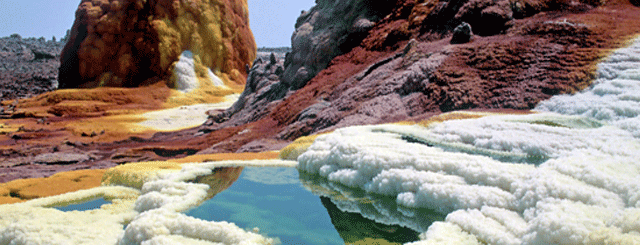
70 km south of Addis Ababa the road forks, to the east is the Afar Region and the Awash River valley, Dire Dawa and the walled city of Harer (to the south are the Rift Valley Lakes and Kenya). After Awash town some 230 kms from Addis Ababa, the road forks again, with the north east fork leading to Hadar, Yangudi Rassa Park, Aissayta and the lakes into which the Awash River drains. North of Aissayta there is Lake Afdera, or the Great Salt Lake, Mount Ert’ale, the only volcano in the world with a permanent lava lake, while further north still lies the Danakil Depression and Dalol, the lowest point below sea level on earth, with its amazing mineral formations, comprising every color of the rainbow. Travellers taking this route to the Depression could ascend the escarpment to Mekele in Tigray.
The eastern fork takes you to the Din Din forest, Dire Dawa, Harer, and for the intrepid traveler, the Somali Region.
You are in Ethiopia for a few days, on business or in transit and quite rightly want to take in something of the country before leaving. This section, Ethiopian Quadrants’ Short Tours – will help you to make best use of your time, explaining what there is to see and do in the time available. Ethiopia is a fascinating and diverse country and once you have sampled it, it is inevitable that you will come back for more. If you have the time, the 2 days can easily be extended into 3, as most of the places described here are well worth a second night.
These tours are all road journeys, but it is possible to visit places on the Historic Route – Axum, Lalibela, Gondar and Bahir Dar – or Harer via Dire Dawa – by air, flying out one day from Addis Ababa and returning the following day. Ask us for more details.
For both your short and longer trips Ethiopian Quadrants will provide advice on the itinerary, good vehicles, experienced guides and the best service at reasonable rates.
Introduction
If you take Addis Ababa as the hub, there are 6 main roads coming out like spokes to the North, North East, South East, South, South West and West.
To the north is the Gojjam road, to Debre Libanos, the Blue Nile Gorge and Bahir Dar. The road to the northeast is the Dessie or Asmara Road, which will take visitors to the Senbete Market, Kombolcha and Dessie. Travelling south and south east we can take the Expressway, staying on it if we are continuing east, to Awash and Harer, and getting off at Mojo if we are going south to the Rift Valley lakes.
The road directly south is the Butajira road, the road to the southwest is the Jimma Road, while the road to the West is the Ambo Road – the last two meet in Gambella near the border with Sudan.
On these routes there are a variety of attractions for visitors, from historic and religious sites, to bird life and wild life and places of scenic beauty. For convenience sake we will take each route in turn, starting with Addis Ababa itself. While some visitors may be less interested in bird life, the birds we can expect to see will be mentioned in each tour.
[list_tours id=”560″]
Duration: 10 day Book Now! Day 1: Arrive Addis Ababa, drive to Debre Libanos. Ethio-German Lodge. Day 2: Drive to Awash National Park. Awash Falls Lodge Day 3: Around Awash…
Wildlife- Ethiopian Endemic Mammals
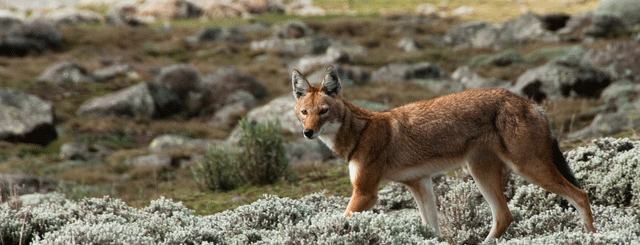
Ethiopia’s troubles over the last four decades, including population displacement and wars, and the burgeoning population increase, have taken their toll of wild life. There is also the issue of resource allocation and management, in terms of making money and personnel available for developing and staffing the parks.
For a full description of Ethiopia’s national parks, animal sanctuaries and protected wildlife areas visit the very informative website of the Ethiopian Wildlife Conservation Authority at http://www.ewca.gov.et/
For big game, it is necessary to go to the following parks:
Chebera Churchura National Park, some 460 km south west of Addis Ababa. Common mammals include the African elephant, hippopotamus, Cape buffalo, lion, and leopard. Currently, CCNP appears to be the least disturbed and reliable ecosystem for the African elephant and Buffalo in the country.
Access is relatively easy but poor internal roads. There are now four lodges in the park, Chebera Safari Lodge, Chebera Elephant Paw Lodge, Shoshima Lodge, Bulo Lodge, with more planned, and it also is possible to camp at different locations in the park.
Omo National Park, with 73 mammal species, including lions, leopards, Cape Buffalo, giraffe and African Elephants, and 312 bird species. Easy access, but poor internal roads, camping necessary.
Mago National Park, 77 mammal species, including lions, leopards, Cape Buffalo and African Elephants, and 237 bird species. Easy access, though rains can make crossing into the park difficult, camping necessary. Most visitors enter the park to visit the villages of the Mursi people (see Omo Valley, Ethnic Tourism)
Gambella National Park: Buffalo, Giraffe,Taing (Topi), Waterbuck, Roan Antelope, White-eared Kob, Nile Lechwe, Burchell’s Zebra, Bushbuck, Reedbuck, Warthog and Elephant. The rivers host healthy populations of Hippopotamus and Nile Crocodiles. Poor internal roads, camping necessary.
For more accessible parks, on the tourist circuits, and with accommodation available, in Awash Park different plains animals may be seen, including greater and lesser Kudu, Beisa Oryx, Gerenuk and Dikdik, and if you are lucky, leopards and lions. The nearby Alledeghi Reserve is well worth a visit, for herds of plains animals and rarely, the Abyssinian Wild Ass. In the Bale National Park various endemic animals can easily be seen, such as Mountain Nyala, Simien Wolf or Ethiopian Wolf and Menelik’s Bush buck, while the adjacent Harenna Forest has wild dogs, lions, and the Bale Monkey. In the Simien Mountains National Park, the Walia population has witnessed a remarkable increase, and now sightings are more or less guaranteed.
Swaynes Hartebeest can easily be seen along with other plains animals in the Senkele sanctuary near Hawassa, and further to the South West, Nech Sar Park, straddling two lakes, combines wonderful scenery with a variety of bird life and wildlife.
In Babile Elephant Sanctuary, some 40 east of Harer, it is possible to see elephants and other game, and up in the north, in Tigray Region, in the new protected area Kafta Sheraro Park, elephants and other wild animals are making a comeback.
© 2026 Ethiopian Quadrants . All rights reserved.